
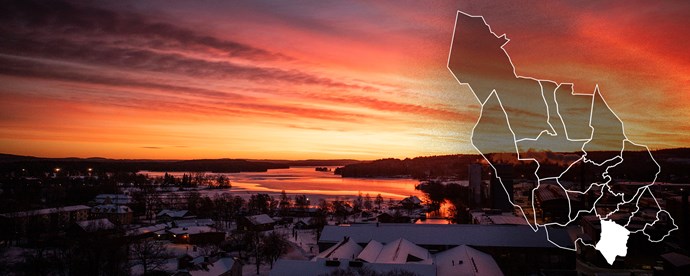
Smedjebacken
Smedjebacken – An Iron Municipality Committed to Sustainability
A Pioneer in Eco-Municipality Development
Smedjebacken, located in southern Dalarna, is renowned for its iron industry and stunning natural surroundings – lakes, forests, and the historic Strömsholm Canal. Perhaps it is this unique environment that inspired Smedjebacken to become one of Sweden’s first eco-municipalities back in 1990. The municipality’s vision is clear: to create a welcoming community built on engagement, safety, and confidence in the future.
Steel and Wood at the Core – and Smart Energy on the Rise
With its rich natural resources, Smedjebacken’s traditional industries have long been steel and wood. The Smedjebacken rolling mill began operations in 1856, laying the foundation for what is today Ovako Bar AB – a leading European manufacturer of component steel for the ball bearing, transportation, and manufacturing sectors. Ovako is proud to be the world’s first steel company to use hydrogen for heating and to operate with 100% carbon neutrality. Around 350 employees work at the Ovako site in Smedjebacken.
Hitachi Energy is also expanding in the municipality, driven by global demand for energy transition solutions. In recent years, the company has established two new factories in Smedjebacken, following major investments. These facilities produce advanced power electronic valves for high-voltage direct current (HVDC) transmission and power quality solutions. They will employ approximately 200 people locally.
Sustainability Rooted in Everyday Life
Smedjebacken joined the National Association of Swedish Eco-Municipalities in 1990, becoming one of the first municipalities in Sweden to adopt this forward-thinking approach. The initiative promotes resource efficiency and environmental awareness, influencing everything from schools and energy supply to waste management. The eco-municipality concept has played a key role in integrating sustainability into daily life and fostering a society adapted to the ecological cycle.
Connected to Sweden – and Beyond
Since 2016, residents have enjoyed direct train service to Stockholm, making it possible to leave Smedjebacken at 6:00 a.m. and arrive in the capital before 9:00 a.m. For those who prefer a slower pace, the historic Strömsholm Canal offers a 110 km waterway from Lake Barken in Smedjebacken to Lake Mälaren near Stockholm – a scenic route that connects the municipality to the world.